Whitefriar Street Church
Overview
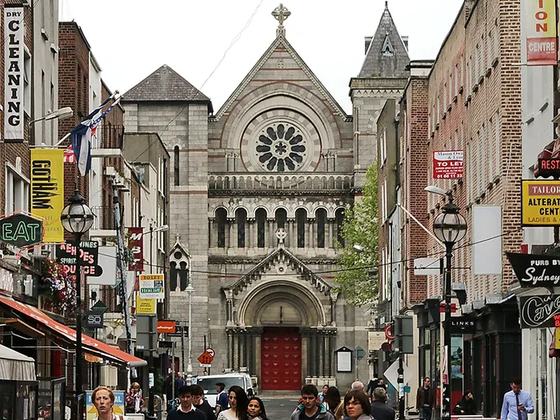
Visitors to Dublin City can find Whitefriar Street Carmelite Church in the city centre, not far from St Patrick’s Church, another of the city’s ecclesiastical sites.
Whitefriar Street Church was founded in 1279, dispossessed during the Reformation and then re-established in 1825. Since 1974, it has been under the care of the Order of Carmelites.
The house of worship has notable details including a shrine with the remains of St Valentine, which Pope Gregory XVI gifted to the church in 1836. On Feb. 14th the relics are displayed specially. Couples often light candles at St Valentine's Shrine, hoping to have their relationships blessed.
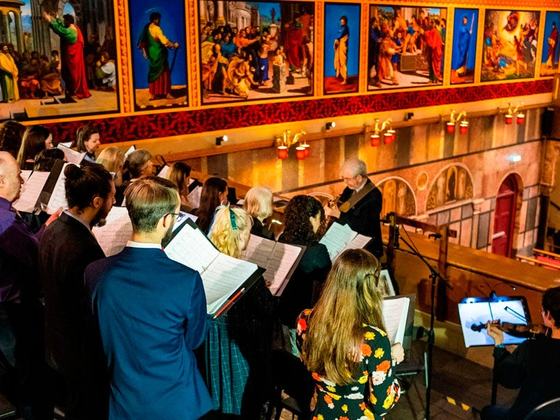
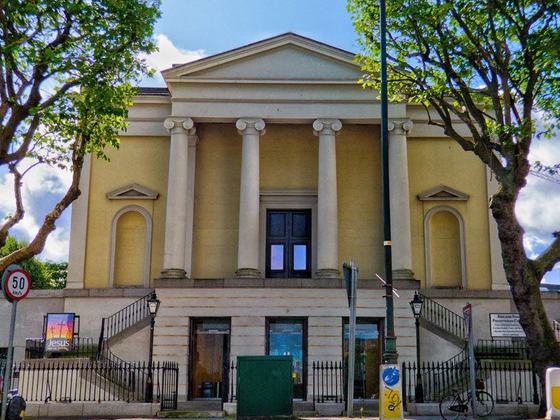
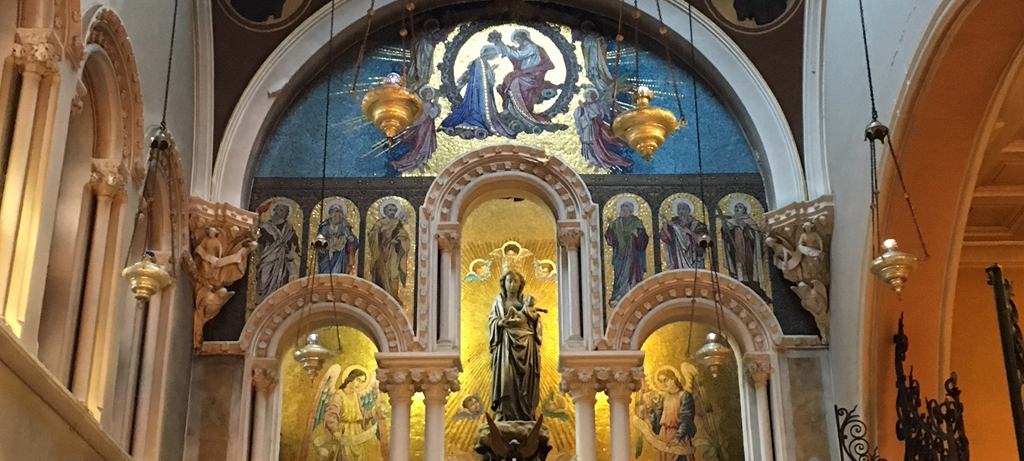
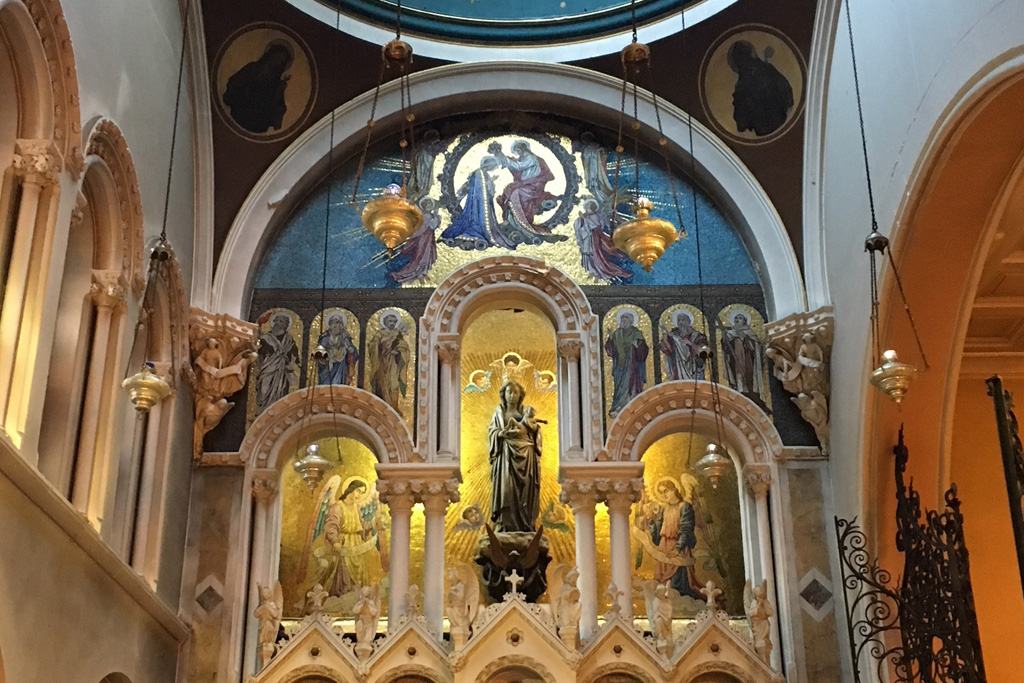
The Church is virtually unchanged since 1844 and contains stunning stained-glass windows and 16 fine statues and shrines. Notable shrines include Our Lady of Dublin which is a rare remnant of the much older former Cistercian Abbey (called St Mary's) that used to exist on Abbey St., the shrine of St Albert of Sicily provides water that is thought to have curative properties. The Rosary windows, perhaps the oldest in the Church, were crafted in the workrooms of Early's of Camden St.; one is dated 1831.
Photography is permitted between worship services.
The first Carmelites arrived in Ireland in the 1270s, and established a friary at Leighlinbridge in Co. Carlow. In Dublin, Sir Robert Bagot, chief justice of the King’s Bench, built them a house in St Peter’s parish on the south side of the little walled city of Dublin. He had bought this bit of land (on which modern Whitefriars stands) from the Cistercian Abbey of Baltinglass in Co. Wicklow. The priory thrived but dark times were to come in the form of the Protestant Reformation during the sixteenth century. The suppression of the Irish houses began with places like White Abbey in Kildare town. Whitefriars, Dublin, was surrendered on August 3, 1539.
Early in the seventeenth century, the Carmelites were back in Dublin, and had established themselves in Cook Street. By 1728, the Carmelites had settled themselves in Ashe Street. They remained there, working amongst the Dublin people and in the surrounding districts, until the lease of their house expired and the landlord would not renew it. They then moved to a house in French Street (later called Upper Mercer Street) and built a chapel in Cuffe Lane close by. This was in 1806.
A Dublin youth, John Spratt, had, after being attracted to the Order at its Dublin chapel, gone to Spain and received the Carmelite habit in Cordova. When he returned, he came to the Dublin house, of which he was soon made prior. He set himself, like so many other Catholics at this time, to try to do something for the education of the children of the Catholic poor, and accordingly opened his first school in Longford Street in 1822. This was moved to a more spacious site in Whitefriar Street in 1824.
The Longford Street property had been part of medieval Whitefriars. Fr Spratt managed to acquire more of the old site. The Community moved to Whitefriar Street in 1825 and, a year later, the Archbishop of Dublin laid the foundation stone of the new church. The architect, George Papworth (1781-1855), was also the designer of Dublin’s St Mary’s Pro-Cathedral on Marlborough Street, and of a number of large country houses in Ireland. Although an account of the new building remarked that “the whole expense is about £4,000; and proves how much can be done with small means, when taste and judgment are combined,” the debt was a heavy one for the Irish Carmelites.
Opening hours
Monday, Wed Thurs Friday 7.30am to 5pm, Tuesday 7.30am to 9pm, Saturday 7.30am to 7pm.
More Historic Sites
Browse all places